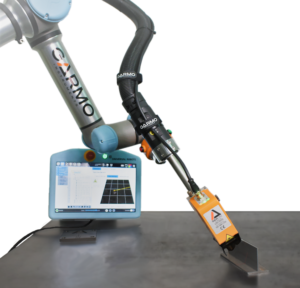
A Human-Robot Partnership for Enhanced Productivity
The manufacturing industry is rapidly embracing automation to increase efficiency and address labor shortages.
What Makes Cobots Different?
Unlike traditional industrial robots that operate in isolation within safety cages, cobots are designed for direct interaction with humans in a shared workspace.
- Increased Efficiency: Cobots can handle repetitive and physically demanding welding tasks, freeing up skilled welders to focus on more complex and intricate operations.
- Improved Quality: Cobots deliver consistent and precise welds, reducing errors and rework, leading to higher-quality products.
- Enhanced Safety: Cobots are designed with safety in mind, minimizing the risk of workplace accidents and injuries.
Their sensors can detect human presence and adjust their movements accordingly. - Greater Flexibility: Cobots are easily reprogrammed and redeployed for different welding tasks, making them adaptable to various production needs and changes in demand.
- Cost-Effectiveness: Cobots can help reduce labor costs and improve productivity, leading to a faster return on investment.
Applications of Cobots in Welding:
- Arc Welding: Cobots can perform various arc welding processes, such as MIG, TIG, and plasma welding, with high precision and repeatability.
- Spot Welding: Cobots excel at repetitive spot welding tasks, particularly in high-volume production environments.
- Material Handling: Cobots can assist with loading and unloading workpieces, freeing up human welders for core welding tasks.
Integrating Seam Tracking Sensors with Cobots
To further enhance the capabilities of cobots in welding, advanced sensor technologies like laser vision seam tracking can be integrated.
Benefits of Laser Seam Tracking in Cobot Welding:
- Improved Accuracy: Ensures precise weld placement, even with complex joint geometries or inconsistent workpiece positioning.
- Increased Speed: Reduces cycle time by eliminating the need for manual adjustments and rework.
- Enhanced Quality: Produces consistent, high-quality welds that meet stringent standards.
The Future of Collaborative Welding
Cobots are transforming the welding landscape, offering a collaborative approach that combines the best of human skills and robotic capabilities.
0 comentarios